


Blog
Schneider BME Series Modules: Models, Functions & Selection Guide

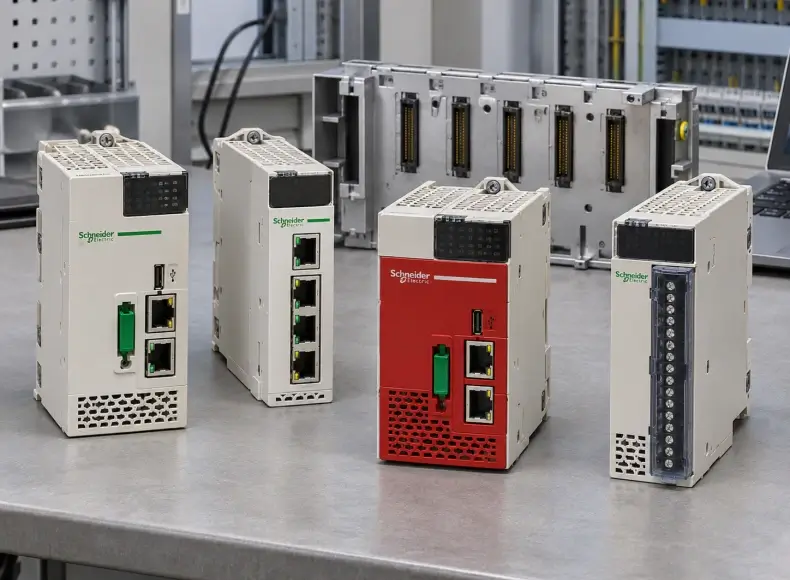
Schneider BME modules include PLC processors, industrial Ethernet communication modules, rack backplanes, remote I/O adapters, safety-related components, and specialist I/O modules used in Schneider Electric Modicon automation systems. Common references include BMEP583040, BMENOC0301, BMEXBP0800, and BMECRA31210. Although these products share the BME prefix, they perform different functions and cannot be selected or replaced on the basis of the prefix alone. Engineers should identify the complete part number, module function, compatible rack, controller architecture, and firmware requirements before ordering.
What Are Schneider BME Modules?
The BME designation appears in multiple Schneider Electric automation product references. Many of these components belong to the Modicon M580 automation platform, while others form part of the wider Modicon X80 I/O architecture.
These components work together in different parts of an industrial control system. A processor executes control logic, an Ethernet module manages network communication, a backplane provides the mounting and internal connection infrastructure, and an I/O adapter connects remote equipment to the controller.
Therefore, a list of BME part numbers should not be treated as a list of equivalent PLC CPUs. The first task is to identify what each module actually does.
Schneider BME Module Types and Model Comparison
The following reference list groups commonly requested BME models by their primary functions. It includes standard processors, high-availability and safety components, communication modules, rack backplanes, and remote I/O hardware.
| Module Category | Product Models | Main Function |
|---|---|---|
| Standard PLC processors | BMEP581020, BMEP582020, BMEP583040, BMEP584020, BMEP584040, BMEP586040 | Application execution, local I/O management, and supported industrial communication |
| High-availability processors | BMEH582040, BMEH584040 | Processor hardware for supported hot standby control architectures |
| Safety system components | BMEP584040S, BMEP58CPROS3 | Safety-related processing and the required safety coprocessor function |
| Ethernet communication and networking | BMENOC0301, BMENOC0311, BMENOC0321, BMENOS0300 | Industrial Ethernet communication, network services, and network segregation |
| Ethernet/X-bus backplanes | BMEXBP0400, BMEXBP0800, BMEXBP1200 | Mounting and internal bus connections for supported modules |
| Remote I/O adapter | BMECRA31210 | Connecting a remote X80 I/O drop to a supported control architecture |
| Specialist I/O | BMEAHI0812 | HART-enabled analog input acquisition for supported X80 configurations |
This table is a product identification guide rather than a compatibility matrix. Before using any listed module, confirm its exact application and compatibility in the relevant Schneider Electric documentation.
How to Select Schneider BME PLC Processors
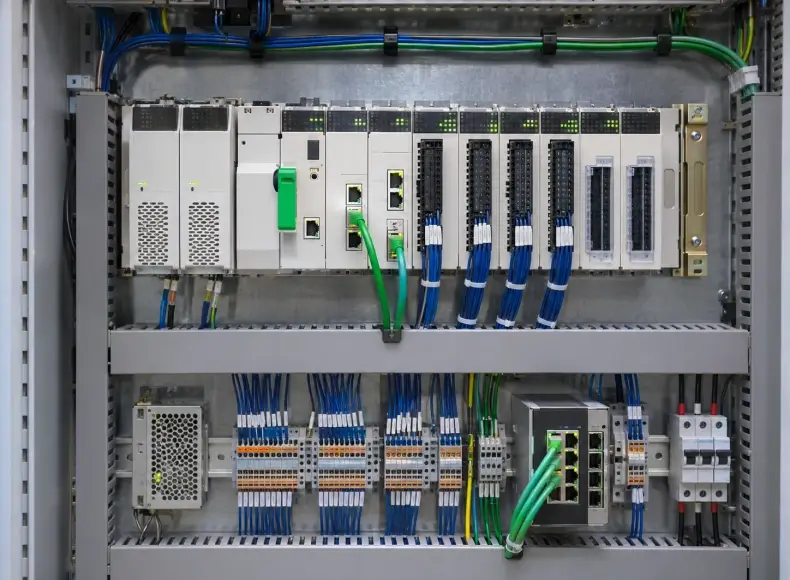
Schneider BMEP processor references cover different M580 controller capacities. Selection depends on the automation project’s I/O requirements, application size, network structure, and supported communication resources.
Standard BMEP processors
The references BMEP581020, BMEP582020, BMEP583040, BMEP584020, BMEP584040, and BMEP586040 belong to different processor configurations within the M580 range.
The model number alone does not provide enough information to calculate a complete system capacity. Engineers must review the processor’s supported rack arrangement, local and remote I/O limits, application memory, and Ethernet communication resources.
For example, BMEP583040 is a standalone processor with 12 MB of application program memory and support for up to 16 remote I/O stations under its specified configuration. A detailed explanation is available in the BMEP583040 Modicon M580 processor guide.
For an existing installation, buyers should first check the original CPU reference and engineering project. This helps determine whether a replacement needs to preserve the same program memory, communication configuration, and I/O topology.
High-availability processors
BMEH582040 and BMEH584040 are associated with M580 hot standby architectures. These systems use redundant processor arrangements to help maintain automation availability when a supported failure or switchover condition occurs.
However, ordering a BMEH processor does not automatically create a redundant control system. Hot standby operation requires a supported processor pair, appropriate communication connections, compatible rack hardware, and correctly configured software.
When maintaining an existing hot standby installation, confirm both processor references and the associated firmware and project configuration before replacing either unit.
BME Safety Components: Processor vs Coprocessor
Safety-related components require a different selection process from standard control hardware. In the supplied BME model range, BMEP584040S and BMEP58CPROS3 belong to the Modicon M580 Safety architecture.
The BMEP584040S is a safety processor, while BMEP58CPROS3 is a safety coprocessor. They perform different functions within the specified safety system configuration.
The BMEP584040S safety processor guide explains its processing role and system requirements.
Safety hardware must be selected according to the approved system architecture, applicable hardware revisions, supported firmware and software, and the required safety engineering process.
A standard M580 CPU should not be described as a direct replacement for a safety CPU. Similarly, a safety processor alone does not establish the safety integrity of the entire machine or process installation.
BMENOC and BMENOS Communication Modules
Industrial Ethernet communication modules connect compatible automation controllers with distributed devices, remote equipment, and plant networks.
However, the BMENOC and BMENOS references do not all perform identical functions.
| Model | Primary Function | Selection Consideration |
|---|---|---|
| BMENOC0301 | Ethernet communication module | Modbus TCP, EtherNet/IP, network configuration, and firmware compatibility |
| BMENOC0311 | Ethernet communication with additional FactoryCast services | Web-based visualization and diagnostic requirements |
| BMENOC0321 | Control-network communication module | Required control-network architecture and supported connections |
| BMENOS0300 | Network option switch | Ethernet network segregation and topology requirements |
For example, BMENOC0301 provides Ethernet communication services for Modicon M580 systems. Its three RJ45 ports and supported communication protocols make it relevant to industrial network integration.
However, firmware revisions and system configuration can affect compatibility. Engineers considering an existing module or its successor should review the BMENOC0301 Ethernet module and replacement guide before deciding on a migration.
BMENOC0311 should not be selected simply because it resembles BMENOC0301. Its additional services, software requirements, and actual network functions must match the project.
Likewise, BMENOC0321 and BMENOS0300 require separate consideration because their roles in network architecture differ from those of a general Ethernet communication interface.
BMEXBP0400, BMEXBP0800 and BMEXBP1200: Rack Selection
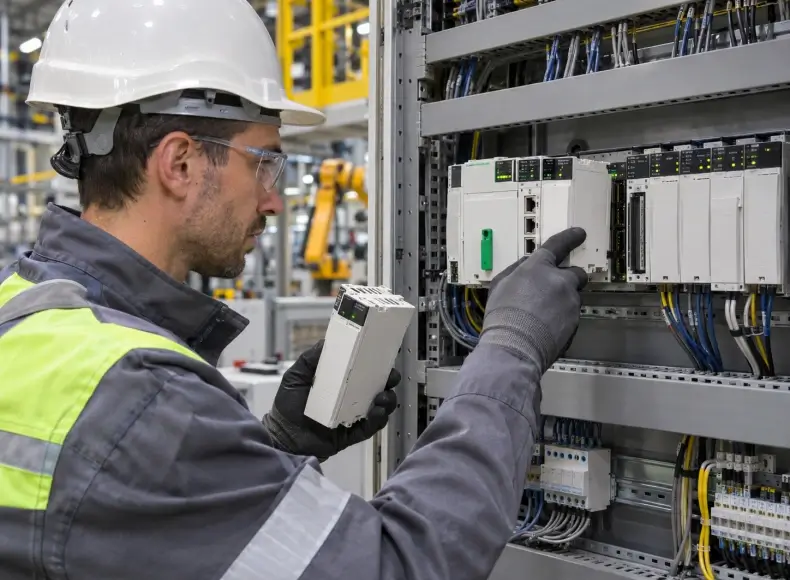
A rack backplane is more than a mechanical mounting frame. It provides the internal infrastructure required for supported processors and modules to communicate and receive power through the appropriate system arrangement.
The BMEXBP family includes several Ethernet/X-bus backplane references:
| Model | Rack Capacity | Primary Selection Factor |
|---|---|---|
| BMEXBP0400 | 4 slots | Compact supported rack configuration |
| BMEXBP0800 | 8 slots | Additional module positions for supported configurations |
| BMEXBP1200 | 12 slots | Larger supported rack configuration |
The number of slots is important, but it is not the only selection criterion. Buyers should confirm the supported processor, power supply arrangement, module placement rules, and any limits imposed by the complete controller architecture.
An eight-slot rack cannot be assumed to accept every combination of eight modules. Some system components have installation restrictions, and communication-module limits can depend on the installed CPU.
BMECRA31210 and BMEAHI0812: Remote I/O and Specialist Signals
Not every BME module belongs in the main processor rack. Remote I/O and specialist signal modules serve different parts of the automation system.
BMECRA31210 remote I/O adapter
The BMECRA31210 is an Ethernet remote I/O adapter associated with the Modicon X80 architecture. Its purpose is to connect a compatible remote I/O drop to the controller’s Ethernet remote I/O system.
When selecting or replacing this adapter, engineers should check the remote rack, supported I/O modules, network topology, firmware requirements, and complete M580 system configuration.
Replacing a remote adapter without documenting the original network arrangement can cause communication or I/O configuration problems even if the physical module appears similar.
BMEAHI0812 HART input module
BMEAHI0812 is a specialist analog input module with HART capability. It is intended for applications that require compatible analog measurement and HART-related device communication.
Unlike a CPU or Ethernet communication module, its primary role concerns field signal acquisition. Selection therefore depends on the connected instruments, required input configuration, and supported X80 rack and system architecture.
For both types of modules, confirm the original hardware reference and connected field equipment before specifying a replacement.
How to Identify the Correct Schneider BME Replacement
When maintaining an existing PLC system, using a product with the same prefix is not enough. The correct replacement depends on the function and configuration of the original device.
- Confirm the full part number: Record the complete BME reference, including any relevant suffixes.
- Identify the module function: Determine whether it is a CPU, network module, backplane, remote adapter, or I/O component.
- Check the existing system: Record the processor, rack and power supply references.
- Review hardware and firmware: Confirm the supported product revision and engineering software version.
- Document the application: Preserve the original PLC project, communication settings, and I/O arrangement.
- Evaluate replacement limitations: Review mechanical compatibility, network configuration, and any manufacturer-designated successor.
- Plan recommissioning: Test communication and relevant control functions before returning the system to production.
Safety-related systems also require the applicable safety validation and approved maintenance procedures.
Schneider BME Module Model Reference List
The following model index helps buyers identify commonly requested references across processor, communication, rack, and I/O categories. It is a reference list, not a declaration that the models are interchangeable.
Schneider BME Module Model Reference List
Explore Schneider BME modules, including PLC processors, Ethernet communication modules, safety components, backplanes, and remote I/O equipment. Select a model below to view its product information.
| BMEP581020 | BMEP582020 | BMEP583040 | BMEP584020 |
| BMEP584040 | BMEP586040 | BMEH582040 | BMEH584040 |
| BMEP584040S | BMEP58CPROS3 | BMENOC0301 | BMENOC0311 |
| BMENOC0321 | BMENOS0300 | BMEXBP0400 | BMEXBP0800 |
| BMEXBP1200 | BMECRA31210 | BMEAHI0812 |
For model-specific sourcing, provide the complete reference, installed system details, required quantity, product condition requirements, and delivery destination.
Frequently Asked Questions
What are Schneider BME modules used for?
Schneider BME modules include PLC processors, communication interfaces, backplanes, remote I/O adapters, safety-related components, and specialist I/O hardware used in compatible Modicon automation systems.
Are all Schneider BME modules part of the M580 series?
No. Many BME references belong to Modicon M580 systems, while others are part of the broader Modicon X80 architecture. The complete product reference determines the module’s function and system compatibility.
What is the difference between BMEP and BMENOC modules?
BMEP references in this guide identify PLC processors, while BMENOC references identify Ethernet communication modules. They perform different functions and are not interchangeable.
Can one Schneider BME module replace another with a similar model number?
Not automatically. Buyers must check module function, electrical requirements, rack compatibility, firmware, network configuration, and the original control-system design before replacing a part.
What information should buyers provide when ordering a BME module?
Provide the complete model number, original module label, existing processor and rack references, hardware or firmware details where available, required quantity, and delivery destination.
Conclusion
Schneider BME modules cover several different functions within industrial automation systems, from processing and communication to rack infrastructure and field signal acquisition. Their shared model prefix does not establish identical performance or compatibility.
For reliable purchasing and maintenance, identify the module’s function first. Then confirm the exact reference, supported system architecture, hardware revision, and application requirements before selecting a replacement.
If you are sourcing a Schneider BME component, send your full part number and existing system details to Siesource Industrial for a product enquiry.