


Blog
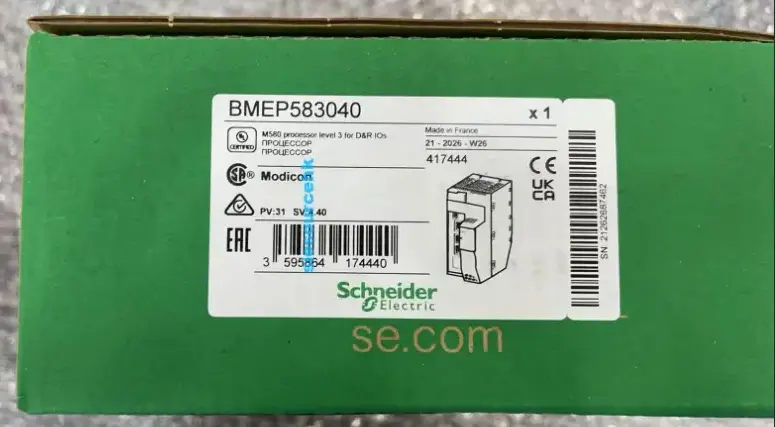
Schneider BMEP583040 Specs: Modicon M580 PLC Processor Guide

The Schneider Electric BMEP583040 is a standalone Modicon M580 programmable automation controller (PAC) processor with 12 MB of application program memory, three integrated Ethernet ports, and support for up to 16 remote I/O stations. It supports 3,072 discrete and 768 analog local I/O points, making it suitable for medium-to-large industrial automation systems. Before selecting or replacing this processor, engineers should verify rack compatibility, network architecture, firmware versions, and application memory requirements.
Schneider BMEP583040 Technical Specifications
The BMEP583040 is a Level 3 M580 processor designed for applications requiring both local control and distributed Ethernet I/O. Its published specifications define the maximum capacity of the processor, rather than a guaranteed capacity for every system configuration.
| Specification | Details |
|---|---|
| Manufacturer | Schneider Electric |
| Product family | Modicon M580 |
| Model number | BMEP583040 |
| Product type | Standalone PAC / PLC processor |
| Processor level | Level 3 |
| Integrated program memory | 12 MB RAM |
| Integrated data memory | 1,024 KB RAM |
| System memory | 10 KB RAM |
| Expandable data storage | Up to 4 GB flash |
| Maximum local discrete I/O | 3,072 points |
| Maximum local analog I/O | 768 points |
| Maximum local rack configuration | 8 racks |
| Remote I/O stations | Up to 16 |
| Maximum racks per remote drop | 2 |
| Distributed equipment capacity | Up to 64 devices |
| Ethernet service ports | 1 |
| Ethernet device-network ports | 2 |
| USB connection | Mini-B |
| Communication services | RIO scanner and DIO scanner |
| Current consumption | 295 mA at 24 V DC |
| Power supply | Internal supply through the rack |
| Operating temperature | 0°C to +60°C |
| Protection rating | IP20 |
| Net weight | Approximately 0.849 kg |
These specifications are based on the Schneider Electric BMEP583040 product information and the official technical datasheet. Confirm the latest product documentation before finalizing the configuration.
How Does the BMEP583040 Work in an M580 System?
The BMEP583040 executes the control application, processes I/O data, and coordinates communication between connected automation devices. Unlike a standalone communication module, it functions as the main processor of an M580 control system.
The processor exchanges information with local X80 I/O modules through the rack backplane. It also supports Ethernet remote I/O and distributed equipment through its integrated network interfaces.
In a typical industrial installation, the processor performs three main functions:
- Application execution: Processes control logic, operating conditions, and programmed sequences.
- I/O management: Exchanges data with local and remote input/output modules.
- Network communication: Connects the automation controller to compatible Ethernet equipment and supervisory systems.
The processor can support application-specific modules for functions such as motion control, counters, HART communication, and time stamping. These capabilities depend on the selected modules and the supported project configuration.
Understanding the 12MB Memory and I/O Capacity
Program memory versus data memory
The BMEP583040 provides 12 MB of integrated RAM for application programs and 1,024 KB for data. These memory areas have different purposes and should not be treated as interchangeable.
Program memory stores the executable automation application. Data memory supports the variables and information required during application operation.
The processor also supports expandable flash storage of up to 4 GB for data storage. This does not mean the PLC has 4 GB of application execution memory.
Local I/O capacity
Schneider specifies a maximum local capacity of 3,072 discrete I/O points and 768 analog I/O points. These figures provide a reference for planning medium-to-large control applications.
Actual usable capacity depends on rack layout, module selection, communication configuration, and application requirements.
The processor supports up to eight local racks. Engineers should confirm the approved rack and expansion configuration before calculating the number of modules that can be installed.
Ethernet Ports and Remote I/O Architecture
Network architecture is one of the most important factors when selecting an M580 processor. The BMEP583040 includes three integrated Ethernet RJ45 interfaces and a Mini-B USB service connection.
Ethernet service and device-network ports
One Ethernet port is designated for service functions, while two ports support the device network. Schneider identifies the BMEP583040 as a processor capable of Ethernet remote I/O scanning.
The two device-network ports can participate in the appropriate RIO network topology. Their permitted use depends on the configured architecture and the manufacturer’s network design rules.
For additional communication requirements, Schneider offers separate network modules. The BMENOC0301 Ethernet communication module guide explains an expansion option within the M580 family.
The BMENOC0301 is a communication module, while the BMEP583040 is the main processor. They perform different functions, and compatibility must be verified for the intended hardware and network configuration.
Remote I/O stations and distributed equipment
The processor supports up to 16 remote I/O stations, with up to two racks per remote drop under the specified architecture. Schneider also lists support for up to 64 distributed equipment devices.
These are separate capacity limits. They should not be combined into a single total for every Ethernet device connected to the system.
For applications involving multiple remote cabinets, engineers should assess network topology, communication loading, I/O response requirements, and available expansion capacity.
BMEP583040 vs BMEP584040S: Which Processor Is Suitable?
The BMEP583040 and BMEP584040S belong to the Modicon M580 family but are intended for different control requirements.
| Feature | BMEP583040 | BMEP584040S |
|---|---|---|
| Processor type | Standard standalone PAC | Standalone safety processor |
| Standard program memory | 12 MB | 16 MB |
| Safety program memory | Not applicable | 4 MB |
| Maximum local discrete I/O | 3,072 | 4,096 |
| Maximum local analog I/O | 768 | 1,024 |
| Remote I/O capacity | Up to 16 stations | Check the approved safety architecture |
| Safety coprocessor | Not required for standard operation | Required for the specified safety configuration |
| Primary selection factor | Standard process and machine control | Safety-related automation applications |
The BMEP584040S should not be selected merely because it offers more memory. Safety applications require additional engineering, compatible hardware, and validated software.
For further technical information, see the Schneider BMEP584040S Safety processor guide.
Applications and Replacement Considerations
The BMEP583040 is suitable for evaluation in industrial applications requiring local processing combined with Ethernet remote I/O.
Typical applications include:
- Process automation: Coordinating field instruments, valves, and production equipment.
- Manufacturing systems: Executing control logic across equipment and distributed I/O cabinets.
- Water treatment: Managing pumps, process measurements, and remote control stations.
- Industrial infrastructure: Integrating automation equipment across multiple locations within a plant network.
These applications are examples rather than guarantees of suitability. Actual requirements depend on the connected equipment, response times, control logic, and network design.
What should be checked before replacing the processor?
Replacing an M580 CPU requires careful attention to the existing project and hardware configuration. A processor with similar memory or I/O capacity is not necessarily a direct replacement.
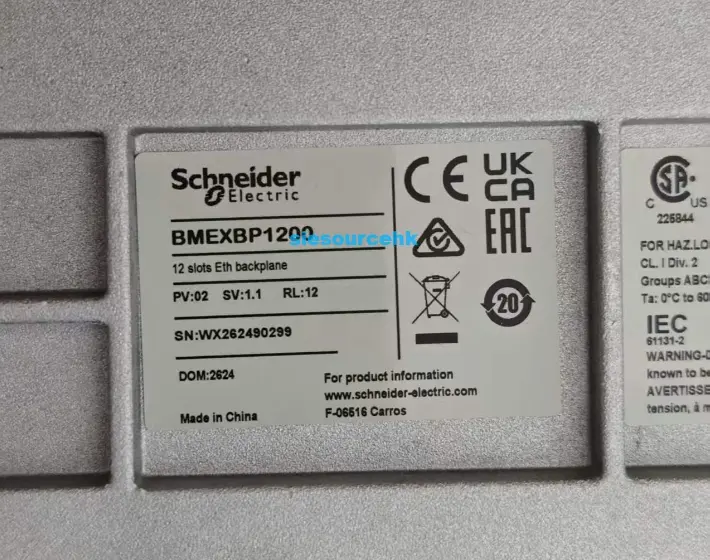
- Confirm the model: Check the complete BMEP583040 reference and hardware revision.
- Review the application: Verify program memory requirements, firmware, and the supported EcoStruxure Control Expert version.
- Check the rack: Confirm the installed backplane, power supply, and module configuration.
- Verify network architecture: Record Ethernet addressing, remote I/O stations, and distributed equipment.
- Protect project data: Follow the approved backup and restoration procedure before removing the existing CPU.
- Test after replacement: Validate I/O operation, communication, diagnostics, and machine or process behavior before returning equipment to service.
For a sourcing enquiry, provide the full processor reference, required quantity, existing rack configuration, and hardware or firmware details. You can submit these details through the Siesource industrial automation enquiry page.
Frequently Asked Questions
What is Schneider BMEP583040 used for?
The BMEP583040 is a standalone Modicon M580 processor used to execute industrial control applications and manage local, remote, and distributed I/O.
How much program memory does BMEP583040 have?
It provides 12 MB of integrated program RAM and 1,024 KB of data RAM. It also supports expandable flash storage of up to 4 GB for data.
How many remote I/O stations does BMEP583040 support?
Schneider specifies support for up to 16 remote I/O stations, with a maximum of two racks per remote drop under the specified configuration.
Is BMEP583040 a safety PLC?
No. It is a standard M580 processor. Safety-related applications require an appropriate safety architecture and compatible safety equipment.
Can BMEP584040 replace BMEP583040 directly?
Not automatically. Engineers must verify firmware, software, rack compatibility, memory requirements, network configuration, and application behavior before selecting another processor.
Conclusion
The Schneider BMEP583040 is a Modicon M580 standalone processor with 12 MB of program memory, integrated Ethernet communication, and support for up to 16 remote I/O stations. Its processing capacity makes it suitable for evaluating distributed industrial control applications. Before purchasing or replacing the CPU, confirm rack compatibility, project requirements, firmware versions, and the complete I/O network configuration.