



Blog
Toshiba VFS15 Inverter Guide: Specs, Model Selection & Replacement

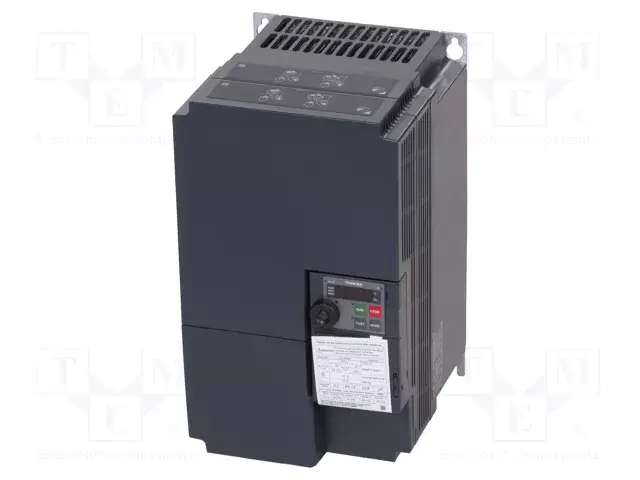
Toshiba VFS15 Inverter: The Professional’s Guide to Specifications and Integration
The Toshiba Schneider Inverter VFS15 (Tosvert VF-S15) has established itself as a cornerstone in industrial automation, specifically for applications requiring high starting torque and compact footprints. Unlike entry-level micro-drives, the VFS15 is engineered for longevity in demanding environments, offering a sophisticated balance between simplicity for the installer and depth for the systems engineer.
Whether you are managing a vertical conveyor system, a complex centrifugal pump, or a high-speed packaging line, understanding the technical nuances of the VFS15 series is critical for optimizing motor performance and ensuring system uptime.
Core Technical Architecture and Power Ratings
The VFS15 series covers a wide power spectrum, accommodating both small-scale machinery and mid-sized industrial equipment. The architecture is primarily categorized by input voltage and phase configuration, which directly dictates the drive’s output capabilities.
Voltage Classes and Capacity Range
Based on industry standards and available stock configurations, the VFS15 is generally segmented into three main branches:
- 1-Phase 240V Input (0.2kW to 2.2kW): Ideal for smaller applications where 3-phase power is unavailable but 3-phase motor control is required.
- 3-Phase 240V Input (0.4kW to 15kW): Commonly used in regional markets with 200-240V grids or specialized high-current machinery.
- 3-Phase 500V Input (0.4kW to 15kW): The standard for heavy industrial environments (380V/400V/480V systems).
Technical Performance Metrics
| Feature | Specification Detail |
| Control Mode | V/f Control, Sensorless Vector Control, Permanent Magnet Motor Drive |
| Starting Torque | 200% at 0.5Hz (Sensorless Vector Control) |
| Overload Capacity | 150% for 60 seconds; 200% for 0.5 seconds |
| Output Frequency | 0.1 to 500 Hz |
| Communication | Built-in RS485 (Modbus RTU), optional CC-Link, PROFIBUS-DP, DeviceNet, EtherCAT |
Advanced Features for OEM and System Integrators
The VFS15 isn’t just a motor speed controller; it acts as a protection and logic hub for the drivetrain. Engineers frequently specify this model due to several “hidden” technical advantages that reduce the need for external components.
1. High-Torque Performance at Low Speeds
In applications like heavy-duty conveyors or crushers, the initial “breakaway torque” is the most significant hurdle. The VFS15’s sensorless vector control calculates the optimal current angle to provide 200% torque even at near-zero speeds. This prevents stalling during startup without needing to oversize the inverter.
2. Side-by-Side Installation (Zero Clearance)
Heat dissipation is a major concern in control cabinet design. Toshiba engineered the VFS15 with a cooling system that allows multiple units to be installed side-by-side with zero clearance. This significantly reduces the cabinet footprint, a critical factor for OEM manufacturers looking to minimize shipping costs and material usage.
3. Integrated Safety and EMI Compliance
The VFS15 includes a built-in EMI noise filter (on specific models) to comply with European EMC directives without requiring external filters. Furthermore, it features a Safe Torque Off (STO) function, meeting safety standards (ISO 13849-1, PLd) to ensure that the motor does not produce torque unexpectedly during maintenance or emergency stops.
Navigating the VFS15 Model Nomenclature
Understanding the model code is vital for procurement and replacement. A typical model number like VFS15-4007PL breaks down as follows:
- VFS15: Series designation.
- 4: Voltage class (4 = 400V class, 2 = 200V class).
- 007: Power rating (007 = 0.75kW, 055 = 5.5kW, 150 = 15kW).
- P/PL: Protection rating and filter configuration.
When sourcing from specialized suppliers, always verify the suffix, as it determines the presence of internal EMC filters or specific regional terminal configurations.
Maintenance and Migration: Replacing Legacy Inverters
In most brownfield industrial sites, the VFS15 is often brought in to replace older Toshiba models like the VF-S11 or even older competitor drives.
Compatibility Checklist
If you are upgrading a legacy system to the VFS15, evaluate the following:
- Terminal Layout: While the VFS15 is compact, its terminal block positioning may differ from older generations. Ensure there is enough “cable slack” in the existing cabinet.
- Parameter Mapping: While Toshiba maintains high consistency, some parameter numbers in the VFS15 (e.g., motor constants) may have updated ranges compared to the VFS11.
- Communication Protocols: If the old drive was connected via a fieldbus (like Profibus), ensure the correct optional communication card is ordered with the VFS15, as these are typically sold separately from the base unit.
Life Cycle Management
Toshiba inverters are designed for a 10-year service life under standard operating conditions (ambient temperature 40°C, 80% load). However, in high-vibration or high-dust environments, the cooling fans—the only moving part—should be inspected every 2–3 years. The VFS15 features a “Design Life Warning” function that monitors the capacitors and fans, providing a signal to the DC output when replacement is nearing.
Procurement Logic: Why Sourcing via Professional Channels Matters
For B2B procurement managers and project engineers, the VFS15 is a “standardized” part, but stock availability can fluctuate based on power rating. Sourcing through platforms that offer comprehensive model listings ensures that you are getting units that match the exact voltage and phase requirements of your specific region.
When requesting a quote (RFQ), specify:
- The full model number (including suffixes).
- The required quantity for project-based pricing.
- Whether you require the external parameter uploader (for cloning settings across multiple drives).
Available Models and Specifications
| model | model | model |
|---|---|---|
| VFS15-4150PL-CH | VFS15-4110PL-CH | VFS15-4075PL-CH |
| VFS15-4055PL-CH | VFS15-4037PL-CH | VFS15-4022PL-CH |
| VFS15-4015PL-CH | VFS15-4007PL-CH | VFS15-2007PM |
| VFS15-2004PM | VFS11-4150PL-WN | VF-S15 |
| VFS15-4037PL-W | VFS15-4150PL-W1 | VFS11-4037PL-AN |
| VFS15-4110PL-W | VFS15-4022PL-WN | VFS15-4150PL-W |
FAQ
Q1: Can the Toshiba VFS15 run a Permanent Magnet (PM) motor?
Yes. Unlike many general-purpose inverters that only support induction motors, the VFS15 has built-in control logic for both standard induction motors and high-efficiency PM motors. This makes it an excellent choice for energy-saving retrofits.
Q2: What is the maximum ambient temperature for the VFS15?
The VFS15 is rated for operation up to 50°C. However, for temperatures above 40°C, the top protective cover must be removed, and the output current should be derated slightly to prevent overheating.
Q3: How do I reset the VFS15 to factory settings?
Navigate to the “Typ” (Type Reset) parameter. Setting this value to “3” (for 60Hz regions) or “13” (for 50Hz regions) will restore all parameters to their original factory defaults.
Q4: Is the VFS15 compatible with Modbus communication?
Yes, the VFS15 comes standard with an RS485 port supporting the Modbus RTU protocol. This allows for direct integration with PLCs and HMI systems without additional hardware.
Q5: What is the difference between the VFS15 and the VF-FS1?
The VFS15 is a general-purpose high-torque drive suitable for conveyors and lifting. The VF-FS1 is specifically optimized for HVAC applications (fans and pumps), focusing on variable torque and energy-saving features rather than high starting torque.
Reference Sources
- Toshiba Schneider Inverter Corp: Official VFS15 Instruction Manual
- IEEE Xplore: Technical papers on Sensorless Vector Control in Compact Inverters.
- International Electrotechnical Commission (IEC): Standards for Adjustable Speed Electrical Power Drive Systems (IEC 61800).
- Siesource HK: Toshiba VFS Product Catalog & Inventory