



Blog
Siemens 3RW Soft Starter: Selection Guide & Technical Specs

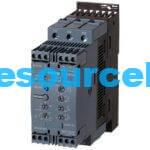
Selecting the right motor control equipment is critical for minimizing mechanical wear and reducing electrical grid stress. The Siemens SIRIUS 3RW soft starter family has long been the industry benchmark for smooth motor starting and stopping. By utilizing thyristors to control voltage and current, these devices eliminate the abrupt torque peaks associated with traditional Star-Delta or Direct-On-Line (DOL) starting.
For engineers and procurement managers, understanding the nuances between the “Basic,” “General Performance,” and “High Performance” tiers is essential for both technical reliability and cost-efficiency.
The Siemens 3RW Spectrum: Categorizing Performance
The SIRIUS 3RW series is divided into three distinct performance classes. Selecting the wrong tier often leads to either unnecessary overhead costs or premature hardware failure due to thermal overloading.
1. Basic Performance: 3RW30 and 3RW40
The 3RW30 is the most compact solution, designed specifically for standard starting. It features two-phase control and is ideal for small motors where space in the control cabinet is a premium.
- 3RW30: Focused on simple starts; lacks integrated electronic motor overload protection.
- 3RW40: Adds integrated electronic motor overload and intrinsic device protection. It is a robust choice for conveyors and pumps requiring Class 10 tripping.
2. General Performance: 3RW50 and 3RW52
These models represent the new generation of soft starters, designed for more versatile industrial applications.
- 3RW50: A compact powerhouse with integrated TIA Portal connectivity and basic HMI options. It supports motors up to 315 kW (at 400V).
- 3RW52: Features three-phase control and optional “Soft Torque” to prevent pressure surges in pumping systems (water hammer). It is the standard choice for most general manufacturing workflows.
3. High Performance: 3RW55 and 3RW55 Failsafe
For heavy-duty applications like crushers, centrifuges, or large fans, the 3RW55 offers advanced torque control and extensive communication protocols (PROFINET, PROFIBUS, Modbus). It supports “Inside Delta” circuits, allowing for even higher power ratings with smaller unit footprints.
Technical Specification Comparison
The following table outlines the key parameters required for electrical engineering evaluation:
| Feature | 3RW30 | 3RW40 | 3RW52 | 3RW55 |
| Control Phases | 2-phase | 2-phase | 3-phase | 3-phase |
| Rated Power (400V) | Up to 55 kW | Up to 250 kW | Up to 315 kW | Up to 710 kW (1200 kW*) |
| Bypass Contacts | Integrated | Integrated | Integrated | Integrated |
| Tripping Class | N/A | Class 10/20 | Class 10/20 | Class 10/20/30 |
| Communication | No | Optional | PROFINET/Modbus | Full TIA Integration |
| Torque Control | No | No | Soft Torque | Advanced Torque |
*When used in Inside-Delta configuration.
Engineering Logic: How to Select the Right Model
Selection should never be based on motor horsepower alone. As a manufacturing consultant, I recommend the “Four-Factor Verification” process:
1. Load Characteristic (Starting Class)
Identify if your load is Class 10 (Standard), Class 20 (Heavy), or Class 30 (Very Heavy). A 3RW40 might handle a standard fan (Class 10), but a heavy-duty centrifuge (Class 30) necessitates the thermal capacity of a 3RW55.
2. Environmental Constraints
Siemens soft starters utilize hybrid switching technology to reduce heat dissipation once the motor is at speed. However, for high-altitude installations or high-ambient temperature panels, derating factors must be applied according to IEC 60947-4-2 standards.
3. Braking and Stopping Requirements
If your application requires a controlled stop to prevent belt slippage or pipe bursts, the 3RW52 or 3RW55 with “Soft Torque” or “DC Braking” is mandatory. Basic units like the 3RW30 only offer a coast-down stop.
4. Digital Ecosystem
If your facility utilizes Siemens TIA Portal or requires real-time energy monitoring, the 3RW5 series is the only logical choice. Their modular communication cards allow for seamless integration into Industry 4.0 architectures.
Industrial Application Suitability
- Pumps and Compressors: The 3RW52 is the preferred model. Its soft torque feature prevents mechanical stress on impellers and eliminates the “water hammer” effect in piping systems.
- Conveyor Systems: For simple logistics, the 3RW40 provides sufficient current limiting to prevent belt stretching while maintaining a small footprint.
- Heavy Industrial Mills: The 3RW55 is required for its ability to handle long starting times and provide the high starting torque necessary to break static friction in loaded mills.
Sourcing and Procurement Considerations
When evaluating suppliers for Siemens automation components, verify their ability to provide technical support and genuine certification. For project managers looking for specific model availability and technical data sheets, the Siemens 3RW product range at Siesourcehk provides a comprehensive database of current inventory, including the latest 3RW5 series and legacy 3RW44 replacements.
For OEM applications, consider the global availability of spare parts. The SIRIUS 3RW5 series is designed for international use, with UL/CSA, CCC, and CE certifications, ensuring compliance across European, North American, and Asian markets.
Available Models and Specifications
| model | model | model | model |
|---|---|---|---|
| 3RW3036-1BB04 | 3RW4900-0KC00 | 3RW4435-6BC44 | 3RW3046-1BB14 |
| 3RW4046-1BB14 | 3RW4426-1BC44 | 3RW4446-6BC44 | 3RW5980-0CP00 |
| 3RW5525-1HA14 | 3RW5524-1HA14 | 3RW5517-1HA14 | 3RW4027-1BB14 |
| 3RW4024-1BB14 | 3RW5544-6HA14 | 3RW4036-1BB14 | 3RW3037-2BB14 |
| 3RW3047-1BB14 | 3RW5527-1HF14 | 3RW4075-6BB44 | 3RW3027-1BB14 |
| 3RW3046-2BB04 | SIRIUS | 3RW5536-2HF14 | 3RW5527-3HF14 |
| 3RW3034-1AB04 | 3RW4026-1BB14 | 3RW4454-6BC44 | 3RW5544-2HF14 |
| 3RW4028-2BB14 | 3RW4036-2BB14 | 3RW4037-2BB14 | 3RW4046-2BB14 |
| 3RW4074-6BB44 | 3RW5143-1XC14 | 3RW3028-1BB14 | 3RW4038-2TB04 |
| 3RW5055-2AB14 | 3RW5526-1HA14 | 3RW3026-2BB04 | 3RW3017-2BB04 |
| 3RW5545-2HF14 | 3RW3045-1AB14 | 3RW5524-1HA16 | 3RW5546-6HA04 |
| 3RW3016-1BB04 | 3RW4028-1BB14 | 3RW3014-1BB14 | 3RW3038-1BB04 |
| 3RW5543-6HA14 | 3RW5983-0TC20 | 3RW5980-0CS00 | 3RW5980-0HF00 |
| 3RW4027-1BB04 | 3RW5224-3TC04 | 3RW5536-6HA14 | 3RW5920-1UA00 |
| 3RW5545-6HA14 | 3RW4037-1BB04 | 3RW4056-6BB44 | 3RW4046-2BB15 |
| 3RW4037-2BB15 | 3RW4024-2BB15 | 3RW4026-2BB15 | 3RW4427-1BC44 |
| 3RW4024-2BB04 | 3RW5074-6AB14 | 3RW4028-1BB04 | 3RW5535-6HA14 |
| 3RW4024-1BB04 | 3RW4037-1BB14 | 3RW3036-1BB14 | 3RW5055-6AB05 |
| 3RW3026-1BB14 | 3RW5077-6TB04 | 3RW5075-6TB14 | 3RW5056-6TB14 |
| 3RW5547-6HA14 | 3RW5548-6HA14 | 3RW5526-3HA14 | 3RW5056-6AB14 |
| 3RW5055-6AB14 | 3RW4036-1BB04 |
FAQ
Q: Can I use a Siemens 3RW soft starter with a single-phase motor?
A: No. Siemens 3RW soft starters are designed specifically for three-phase asynchronous motors. For single-phase applications, different voltage regulation hardware is required.
Q: What is the benefit of “Inside-Delta” wiring?
A: Inside-Delta wiring allows the soft starter to be connected in the individual phases of the motor. This reduces the current flowing through the soft starter by a factor of 1.73, allowing you to use a smaller, more cost-effective unit for the same motor power. This is typically only supported on high-performance models like the 3RW55.
Q: How do I resolve a “Thermal Overload” trip on a 3RW40?
A: First, verify the current setting (Ie) matches the motor nameplate. Second, check the starting frequency (starts per hour). Soft starters require “cool-down” periods between starts. If the application requires frequent cycling, you may need to upgrade to a larger frame size or add external cooling.
Q: Is a bypass contactor necessary for the 3RW5 series?
A: No. All modern Siemens 3RW soft starters feature integrated bypass contacts. Once the motor reaches full speed, the electronics are bypassed to reduce heat and energy consumption, extending the lifespan of the thyristors.
Q: What is the lead time for 3RW55 series models?
A: Lead times vary by region and current rating. Standard sizes (up to 100A) are often in stock, while high-current models (over 600A) may have a lead time of 4–8 weeks depending on global supply chain conditions
Reference Sources
- Siemens AG: SIRIUS 3RW Soft Starters Equipment Manual (Reference Manual for 3RW50, 3RW52, 3RW55).
- IEC 60947-4-2: Low-voltage switchgear and controlgear – Contactors and motor-starters – AC semiconductor motor controllers and starters.
- IEEE Industry Applications Society: Technical papers on Soft Starter vs. VFD efficiency in constant-speed applications.
- Siesourcehk Technical Catalog: Siemens 3RW Series Specifications and Global Sourcing Guide.