



Blog
Siemens 3RV1 vs 3RV2: Differences, Selection & Replacement

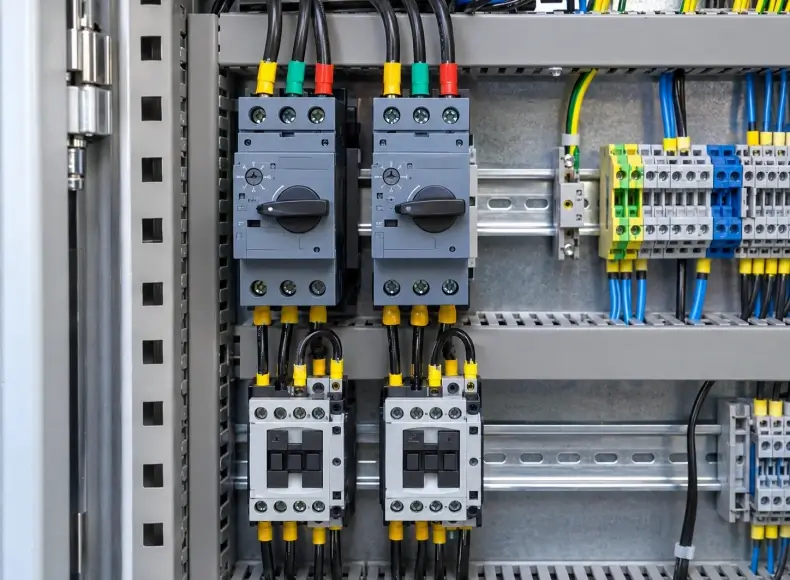
Siemens 3RV1 vs 3RV2 is primarily a comparison between an earlier SIRIUS motor protection breaker generation and a broader range of SIRIUS 3RV2 devices. Both families include breakers designed to protect suitable motor circuits against overloads and short circuits. However, they differ in available frame sizes, rated current ranges, connection options, accessories, and integration with motor starters. A 3RV2 breaker may be a suitable successor to a particular 3RV1 model, but matching the current adjustment range alone does not establish direct replacement compatibility.
What Are Siemens 3RV1 and 3RV2 Motor Protection Breakers?
Siemens SIRIUS 3RV motor starter protectors are manually operated, three-pole protective switching devices used in industrial motor feeders. Standard motor protection versions combine thermal overload protection with magnetic short-circuit protection.
The thermal release responds to prolonged overcurrent, while the magnetic release provides rapid tripping under high fault-current conditions. Their roles are different, and neither rating should be confused with the breaker’s short-circuit breaking capacity.
The older 3RV1 devices remain relevant to maintenance of established industrial equipment. The 3RV2 range includes standard motor protection devices and additional application-specific versions, such as breakers for starter combinations and transformer protection.
Siemens describes these differences in its SIRIUS 3RV Motor Starter Protectors Equipment Manual.
Siemens 3RV1 vs 3RV2: Main Differences
The following comparison describes the product families rather than suggesting that every model within either range has identical ratings.
| Comparison Point | Siemens 3RV1 | Siemens 3RV2 |
|---|---|---|
| Product generation | Earlier SIRIUS generation | Broader, newer SIRIUS range |
| Standard motor protection | Overload and short-circuit protection | Overload and short-circuit protection |
| Frame sizes in the current Siemens equipment manual | S00 for 3RV1011 | S00, S0, S2 and S3 |
| Maximum rated current in the documented range | 12 A for 3RV1011 | Up to 100 A, depending on version and frame size |
| Main-circuit connection options | Screw terminals | Screw terminals; selected versions also offer spring-loaded or ring-cable-lug connections |
| Specialized protection variants | More limited selection in the current manual | Motor protection, starter-combination, transformer and other application-specific versions |
| Accessories | Generation-specific auxiliary switches, releases and mounting components | Accessories designed for the relevant 3RV2 model and size |
| Replacement consideration | Often encountered in existing installations | May provide a successor option after electrical and mechanical verification |
These figures reflect the specific families described in the Siemens equipment manual. Older SIRIUS Classic documentation also covers additional historical 3RV1 frame sizes. Therefore, the full legacy part number is essential when identifying an existing breaker.
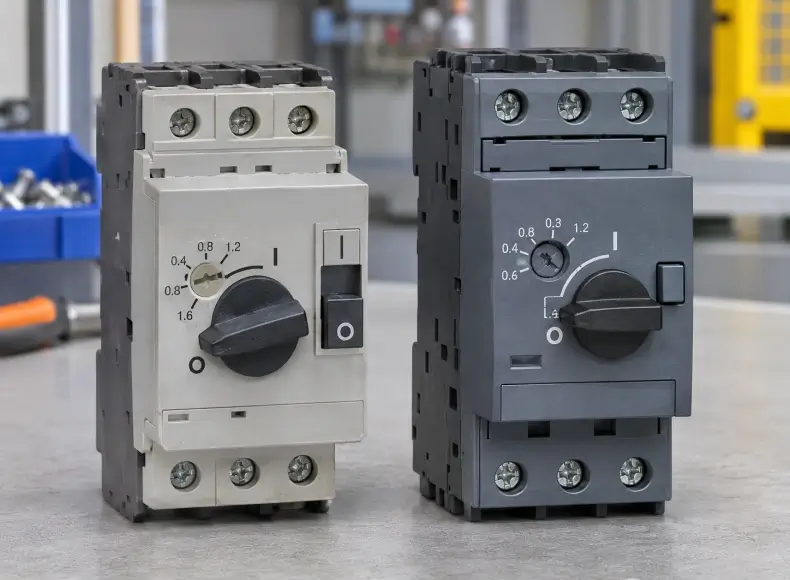
1. Current Adjustment Ranges: The First Selection Check
The adjustable overload release range determines the motor-current values that a standard motor protection breaker can accommodate. It is one of the most important criteria when comparing a 3RV1 unit with a possible 3RV2 replacement.
For example, the Siesource technical catalogue includes the following model references:
| Model | Family | Overload Adjustment Range | Frame |
|---|---|---|---|
| 3RV1011-1EA15 | 3RV1 | 2.8–4 A | S00 |
| 3RV2011-1DA10 | 3RV2 | 2.2–3.2 A | S00 |
| 3RV2021-1BA15 | 3RV2 | 1.4–2 A | S0 |
| 3RV2021-1HA15 | 3RV2 | 5.5–8 A | S0 |
| 3RV2021-4NA15 | 3RV2 | 23–28 A | S0 |
These ratings illustrate why model similarity can be misleading. The 3RV1011-1EA15 and 3RV2011-1DA10 have overlapping adjustment ranges, but they are not electrically equivalent across their entire ranges.
A motor requiring a 3.6 A overload setting falls within the 2.8–4 A range of the 3RV1011-1EA15 but exceeds the upper setting limit of the 3RV2011-1DA10. Therefore, the latter cannot be selected solely because it belongs to the newer 3RV2 family.
For an older installation, the Siemens 3RV1011-1EA15 specifications guide provides further information about the 2.8–4 A device.
For a newer S00 example, see the Siemens 3RV2011-1DA10 motor protection guide.
2. Frame Sizes, Mounting Dimensions and Installation Space
A replacement breaker must fit the existing electrical panel and motor starter arrangement. This is where a 3RV1-to-3RV2 migration can become more complicated than a current-rating comparison suggests.
The current Siemens 3RV equipment manual identifies the 3RV1011 as an S00 device with a 45 mm width. The 3RV2 range includes four principal sizes:
| 3RV2 Size | Typical Width | Maximum Rated Current in the Documented Range |
|---|---|---|
| S00 | 45 mm | 16 A |
| S0 | 45 mm | 40 A |
| S2 | 55 mm | 80 A |
| S3 | 70 mm | 100 A |
These are family-level dimensions and maximum ratings, not specifications for every individual model. Special versions may have different dimensions or installation requirements.
Even when both devices are 45 mm wide, their overall height, depth, terminals, accessory positions, and mounting geometry may differ.
Before ordering a replacement, compare the manufacturer’s dimensional drawings and check the available space inside the control cabinet. Existing busbars and contactor-linking components also need attention.
3. Short-Circuit Protection and Breaking Capacity
Both standard 3RV1 and 3RV2 motor protection breakers use overload and short-circuit protection functions. However, selecting a replacement requires more information than the adjustable thermal setting.
Three values must be distinguished:
- Overload adjustment range: The motor-current setting range used for thermal overload protection.
- Instantaneous magnetic release: The high-current threshold associated with rapid short-circuit tripping.
- Short-circuit breaking capacity: The prospective fault current that the device is rated to interrupt under specified test conditions.
For example, the 3RV1011-1EA15 is documented with a 52 A instantaneous release threshold, while the 3RV2011-1DA10 uses a 42 A instantaneous release threshold. These figures are not equivalent to their respective breaking capacities.
When considering a replacement, verify the applicable Icu and Ics ratings at the installation voltage, the available fault current, and the upstream protection arrangement.
Where the breaker forms part of a motor starter, review the manufacturer’s coordination data for the complete protective and switching assembly. Do not assume that any 3RV2 device can replace a 3RV1 unit without affecting the starter’s tested coordination.
4. Auxiliary Contacts and Motor Starter Compatibility
Motor protection breakers often operate with contactors, auxiliary switches, undervoltage releases, shunt releases, and other accessories. These components can affect both electrical operation and mechanical installation.
The 3RV1 and 3RV2 families have accessories designed around their respective devices. Some accessory types exist in both families, but this does not mean that the same physical accessory can be transferred from an older breaker to a newer one.
Auxiliary contact configuration
An auxiliary switch may provide status signals to a PLC, control relay, or indicator circuit. The required number of normally open (NO) and normally closed (NC) contacts must be preserved when replacing the protective device.
For example, the 3RV1011-1EA15 includes a transverse auxiliary arrangement with 1 NO and 1 NC contact. A replacement must support the control circuit’s required signaling functions.
Contactor and linking components
Motor starter assemblies may use direct linking or connecting modules between a 3RV breaker and a compatible contactor. The newer breaker may require a different connection accessory, even where the rated motor current is similar.
Before installing a new breaker, inspect the associated contactor model, starter mounting arrangement, busbars, terminal connections, and auxiliary wiring.
The goal is not merely to fit the new breaker into the enclosure. The complete starter must retain its intended protection and control functions.
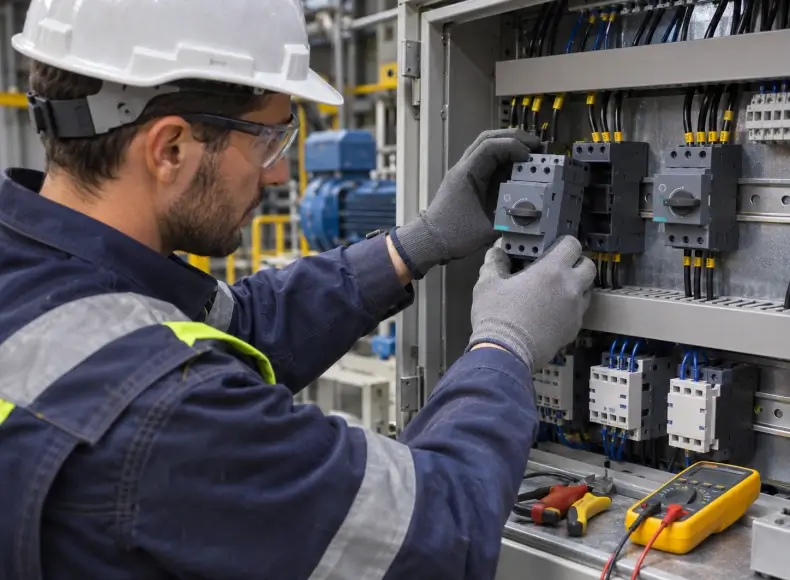
5. When Should You Choose 3RV1 or 3RV2?
Maintaining an existing 3RV1 installation
If a machine was originally designed around a 3RV1 breaker and the identical approved replacement remains suitable for the maintenance requirements, sourcing the exact part number may reduce changes to the existing configuration.
However, older-product availability and lifecycle status vary by model. Buyers should check the manufacturer’s current product status and confirm the condition of any offered spare part.
Designing or upgrading a motor starter
For a new installation or an approved modernization project, the broader 3RV2 range provides additional frame sizes and specialized application options.
The final choice still depends on motor current, trip characteristic, short-circuit ratings, connection method, installation space, and compatibility with the selected contactor.
For example, the Siemens 3RV2021-1HA15 specifications guide covers a 5.5–8 A S0 device. Its current range may suit a different motor application from the lower-current models listed above.
Choosing a newer family is not automatically an upgrade for every existing motor feeder. The entire application must support the selected device.
Can a Siemens 3RV2 Replace a 3RV1 Circuit Breaker?
Yes, a suitable 3RV2 model may replace a particular 3RV1 device when Siemens identifies an approved successor or when the installation has been evaluated and modified as required. However, the two families are not universally interchangeable.
Siemens product records identify preferred 3RV2 successors for certain discontinued 3RV1 references. For example, Siemens lists 3RV2011-0GA20 as the preferred successor to 3RV1011-0GA20. That specific manufacturer recommendation should not be extended to unrelated part numbers.
Replacement checklist
- Record the complete original model: Include the full Siemens ordering suffix, not just 3RV1.
- Check the motor nameplate: Verify rated current at the actual operating voltage and frequency.
- Match the overload setting: Confirm that the required setting falls within the new device’s adjustment range.
- Verify short-circuit performance: Compare breaking capacity, magnetic release characteristics, and coordination requirements.
- Check mechanical fit: Confirm dimensions, mounting, terminals, and conductor clearances.
- Review auxiliaries: Identify any auxiliary switches, releases, or signaling components that need replacement.
- Check the motor starter: Confirm the associated contactor and any linking or busbar system.
- Document the modification: Update the electrical drawings and verify the completed assembly before returning it to service.
Qualified personnel should perform all electrical replacement work in accordance with the equipment instructions and applicable safety procedures.
Siemens 3RV Motor Protection Models for Comparison
The following examples help identify available current ranges across the two SIRIUS families. They are comparison references rather than a list of direct substitutes.
| Model | Product Family | Adjustment Range | Typical Selection Question |
|---|---|---|---|
| 3RV1011-1EA15 | 3RV1 | 2.8–4 A | Is the existing S00 motor starter using this exact older device? |
| 3RV2011-1DA10 | 3RV2 | 2.2–3.2 A | Does the motor rated current fit the lower adjustment range? |
| 3RV2021-1BA15 | 3RV2 | 1.4–2 A | Does the application require protection for a smaller motor current? |
| 3RV2021-1HA15 | 3RV2 | 5.5–8 A | Is the motor current within this S0 adjustment range? |
| 3RV2021-4NA15 | 3RV2 | 23–28 A | Does the larger motor feeder meet the device’s complete electrical ratings? |
For related products, browse the Siemens circuit breaker product category at Siesource Industrial. The category covers a wider range of Siemens breakers; verify the exact 3RV part number before requesting a quotation.
What Should Buyers Provide for a 3RV1 or 3RV2 Replacement Enquiry?
Accurate product identification helps prevent an unsuitable motor protection breaker from being ordered. A useful enquiry should include:
- Original Siemens 3RV1 or 3RV2 part number.
- Photographs of the existing breaker and its nameplate.
- Motor rated current and operating voltage.
- Associated contactor model and connected accessories.
- Any required successor or replacement reference.
- Required quantity and product condition.
- Delivery destination and relevant project requirements.
If the original breaker is obsolete, ask the supplier to confirm the available model and supporting documentation before treating it as a replacement option.
Frequently Asked Questions
What is the main difference between Siemens 3RV1 and 3RV2?
Siemens 3RV1 is an earlier SIRIUS motor protection breaker generation, while 3RV2 offers a broader range of sizes, connection options, and application-specific versions. Both include devices for motor overload and short-circuit protection.
Can Siemens 3RV2 directly replace 3RV1?
Not automatically. A 3RV2 may be suitable when Siemens specifies a successor or when current range, breaking capacity, trip characteristics, dimensions, accessories, and starter coordination have been verified.
Are 3RV1 and 3RV2 auxiliary contacts interchangeable?
Not necessarily. Accessory compatibility depends on the exact breaker model and mounting arrangement. Check the manufacturer’s accessory documentation before reusing auxiliary switches or release modules.
How do I select the correct Siemens motor protection breaker current range?
Start with the motor’s rated current at its operating voltage. Select a device whose adjustable overload range includes the required setting, then verify starting conditions, short-circuit performance, and complete installation requirements.
Does a higher-rated 3RV2 breaker provide better motor protection?
Not automatically. A device with an unsuitable adjustment range may fail to provide the required overload protection. Correct selection depends on the actual motor and feeder specifications rather than choosing the highest-rated breaker.
Conclusion
The Siemens 3RV1 and 3RV2 families share the essential purpose of protecting suitable motor circuits, but their physical designs, product options, accessories, and available current ranges differ. The newer 3RV2 range can provide a replacement path for certain 3RV1 applications, provided the complete configuration is checked.
When maintaining an older motor starter, begin with the original part number and motor data. Confirm the replacement’s electrical ratings, physical installation, accessories, and coordination before making the change.
Need a Siemens 3RV replacement? Send your existing breaker reference, motor details, and quantity to Siesource Industrial for a Siemens motor protection breaker enquiry to discuss the required model and quotation details.