


Blog
Allen-Bradley 1734-IE4C: Specs, Uses & Selection Guide

Allen-Bradley 1734-IE4C: Specs, Uses & Selection Guide
The Allen-Bradley 1734-IE4C is a four-channel analog current input module for the POINT I/O distributed I/O platform. It is designed to bring 0–20 mA or 4–20 mA field signals into a control system.
For engineers selecting an analog input module, the important questions are not only channel count and resolution. Signal type, isolation, update rate, wiring architecture, environmental conditions, and compatibility with the existing POINT I/O installation can affect whether the module is a good fit.
This guide explains the module’s main specifications, practical applications, and selection considerations.
What Is the Allen-Bradley 1734-IE4C?
The 1734-IE4C is a 24V DC, four-channel high-density analog current input module in the Allen-Bradley POINT I/O family. Rockwell Automation lists the product as an active POINT I/O analog input module.
Unlike a PLC processor, the module does not execute the main control program. Its role is to acquire analog current signals from field devices and make that information available to the controller through the POINT I/O architecture.
Typical signal sources include:
- Pressure transmitters
- Flow transmitters
- Level transmitters
- Process instrumentation
- Current-output sensors
- Other industrial devices using 0–20 mA or 4–20 mA signals
Rockwell specifies four single-ended, non-isolated current inputs with 16-bit resolution over a 0–21 mA range. Supported input current terminals are 0–20 mA and 4–20 mA.
Key specifications at a glance
| Parameter | 1734-IE4C |
|---|---|
| Product family | POINT I/O |
| Input channels | 4 |
| Input type | Analog current |
| Signal range | 0–20 mA / 4–20 mA |
| Resolution | 16-bit |
| Input configuration | Single-ended, non-isolated |
| Field power input | 10–28.8V DC |
| Backplane supply | 5V DC |
| Operating temperature | -20°C to +55°C |
| Approx. dimensions | 56.6 × 12.1 × 77.5 mm |
| Approx. weight | 35 g |
| Wiring | Shielded wire recommended |
These figures come from Rockwell Automation’s current installation documentation. Specifications should still be checked against the exact product series and installation requirements before deployment.
How Does the 1734-IE4C Handle Analog Signals?
The module converts current signals from field instruments into digital data that the control system can process.
A common example is a pressure transmitter producing a 4–20 mA signal. The transmitter may represent its configured measurement range across that current span, while the analog input module converts the electrical signal into data for the controller.
The module supports:
- 0–20 mA input signals
- 4–20 mA input signals
- Four analog input channels
- 16-bit resolution
- Selectable input filtering
- Over-range and under-range detection
- Channel-level status information
The current input has an impedance of approximately 60 Ω, while Rockwell specifies 0.1% full-scale absolute accuracy at 25°C for the current terminal. Temperature-related accuracy drift is specified at 30 ppm/°C.
One practical point deserves attention: the four inputs are not individually isolated. Rockwell’s documentation states that there is no isolation between individual inputs or between the inputs and field power.
That matters when field instruments operate at different electrical potentials or when the application has significant grounding and noise concerns.
Where Is the 1734-IE4C Commonly Used?
The module is most useful where several analog current signals need to be collected close to machines or process equipment.
Process monitoring
A distributed I/O station can collect signals from pressure, flow, level, or other transmitters without routing every field signal back to a centralized cabinet.
For example, a skid-mounted process system may use several 4–20 mA transmitters. A four-channel input module can consolidate these signals at a local POINT I/O station.
Machine automation
OEM machinery may use analog feedback for pressure, temperature transmitters with current outputs, hydraulic monitoring, or other process variables.
The compact POINT I/O format can be useful when cabinet space is limited and the machine has multiple distributed control points.
Packaging and material handling
Packaging equipment sometimes combines discrete sensors with analog measurements. A POINT I/O station can accommodate different I/O types within the same broader architecture.
SieSource’s product page describes POINT I/O applications including machine control, packaging and material handling, process monitoring, remote control panels, and OEM equipment integration.
1734-IE4C vs Other POINT I/O Analog Input Modules
Choosing the correct module is easier when the signal type and channel requirement are defined first.
| Module | Main input type | Typical reason to consider |
|---|---|---|
| 1734-IE4C | 0–20 / 4–20 mA | Four current-input channels |
| 1734-IE2C | Current | Fewer current-input channels |
| 1734-IE2V | Voltage | Voltage-based analog signals |
| 1734-IE8C | Current | Higher channel density |
The 1734-IE4C is therefore not simply a generic analog input module. Its main selection criterion is the combination of four current-input channels and POINT I/O system compatibility.
Rockwell’s compatibility documentation also provides Add-On Profiles and EDS files for the 1734-IE4C, which can be important during system configuration.
When should you choose 4–20 mA rather than voltage input?
Current signals are common in industrial instrumentation because they can be transmitted over longer cable runs and are less dependent on voltage drop than simple voltage signals.
However, that does not mean a current input module is automatically the better choice.
If the field device provides 0–10 V or ±10 V, a voltage-input module is normally the more direct match. Converting signal types adds unnecessary hardware and another potential failure point.
The correct approach is to start with the actual output specification of the field device.
Important Installation Considerations
The 1734-IE4C is a small module, but installation details still matter.
Rockwell’s October 2025 installation instructions specify compatible wiring-base assemblies including the 1734-TB, 1734-TBS, 1734-TOP, and 1734-TOPS families. The module is installed on a DIN rail-based POINT I/O system.
The documentation also specifies:
- Shielded wiring for signal connections
- 0.25–2.5 mm² copper conductors
- A maximum operating ambient temperature of 55°C
- Proper DIN rail grounding
- Appropriate field power arrangements
- Correct terminal-base selection
The installation guide shows wiring configurations for current-input devices, including two-wire and four-wire arrangements. A 1734-VTM can also be used where a separate 24V DC source is needed for certain two-wire or three-wire devices.
This is where field experience matters. A module can have the correct electrical range and still perform poorly if signal wiring, grounding, power distribution, or field-device configuration is wrong.
Evaluating the 1734-IE4C for a Project
Before specifying this module, check the following points:
- Confirm the field signal.
Verify whether each instrument outputs 4–20 mA, 0–20 mA, voltage, or another signal type. - Check channel requirements.
Four current inputs may be suitable for a small distributed station, while higher-density installations may benefit from an eight-channel module. - Review isolation requirements.
The 1734-IE4C has non-isolated inputs. Applications requiring channel-to-channel isolation need a different architecture. - Check the existing POINT I/O system.
Confirm the adapter, terminal base, controller environment, and configuration software requirements. - Review environmental conditions.
Temperature, vibration, humidity, hazardous-area requirements, and enclosure design can affect the final installation. - Verify configuration files.
Rockwell provides Add-On Profiles and EDS resources for the module, which can help integrate it into the control system.
This process is more reliable than selecting a module based only on its catalog number.
Product and Supply Information
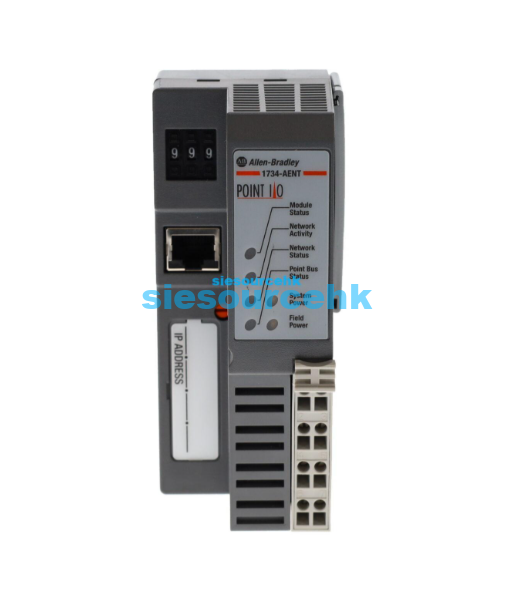
For buyers evaluating a specific Allen-Bradley 1734-IE4C unit, the SieSource product page provides a direct product listing with purchasing and quotation options. The page currently lists the unit as an Allen-Bradley 1734-IE4C and provides a One Click Quote option.
View the Allen-Bradley 1734-IE4C product page on SieSource
The same page describes SieSource as an automation-controls and electronic-components distributor and states that it handles sourcing for obsolete and hard-to-find industrial automation parts.
For an actual purchase, buyers should confirm the series, condition, packaging, included accessories, availability, and applicable warranty rather than relying only on a catalog number.
The listed price can also change with inventory and market conditions, so a current quotation is more useful than treating a displayed web price as a fixed project cost.
What Should You Confirm Before Ordering?
For a replacement or new installation, send the supplier the following information:
- Exact catalog number: 1734-IE4C
- Required series
- Quantity
- New or replacement requirement
- Existing POINT I/O adapter
- Required terminal base
- Destination country
- Required delivery date
- Any documentation or certification requirements
This information reduces the chance of receiving a technically similar module that does not match the existing installation.
For replacement projects, it is particularly useful to provide a photo of the existing module label. The series designation can affect compatibility, documentation, and configuration requirements.
FAQ
Is the Allen-Bradley 1734-IE4C a PLC?
No. The 1734-IE4C is an analog input module, not a PLC processor. It belongs to the Allen-Bradley POINT I/O distributed I/O platform and provides four analog current inputs.
What signals does the 1734-IE4C support?
It supports 0–20 mA and 4–20 mA current input signals. Rockwell specifies four single-ended, non-isolated inputs with 16-bit resolution over a 0–21 mA range.
Is the 1734-IE4C isolated?
No. The inputs are non-isolated, and Rockwell specifies no isolation between individual inputs or between inputs and field power. This should be considered when designing grounding and signal interfaces.
What is the operating temperature of the 1734-IE4C?
The specified operating temperature range is -20°C to +55°C (-4°F to +131°F). Actual system design should also consider cabinet temperature and nearby heat sources.
What terminal bases can be used with the 1734-IE4C?
Rockwell’s current installation instructions identify 1734-TB, 1734-TBS, 1734-TOP, and 1734-TOPS wiring-base assemblies for the module. Always verify the exact installation documentation for the series being purchased.
Is the 1734-IE4C suitable for a replacement project?
It can be, provided the existing system uses compatible POINT I/O architecture and the replacement requirements match the module’s electrical and mechanical specifications. Confirm the exact series, terminal base, adapter, configuration, and environmental requirements before ordering.
Reference Sources
- Rockwell Automation — 1734-IE4C Product Page
Rockwell Automation 1734-IE4C official product documentation - Rockwell Automation — 1734-IE4C Installation Instructions, Publication 1734-IN032H-EN-P
1734-IE4C Installation Instructions PDF - Rockwell Automation — POINT I/O Technical Documentation
POINT I/O Technical Documentation - Rockwell Automation — Product Compatibility & Downloads
1734-IE4C Compatibility and Downloads - SieSource — Allen-Bradley 1734-IE4C Product Page
SieSource Allen-Bradley 1734-IE4C