



Blog
Siemens Motor Protection Circuit Breaker Tripping: Causes & Checks

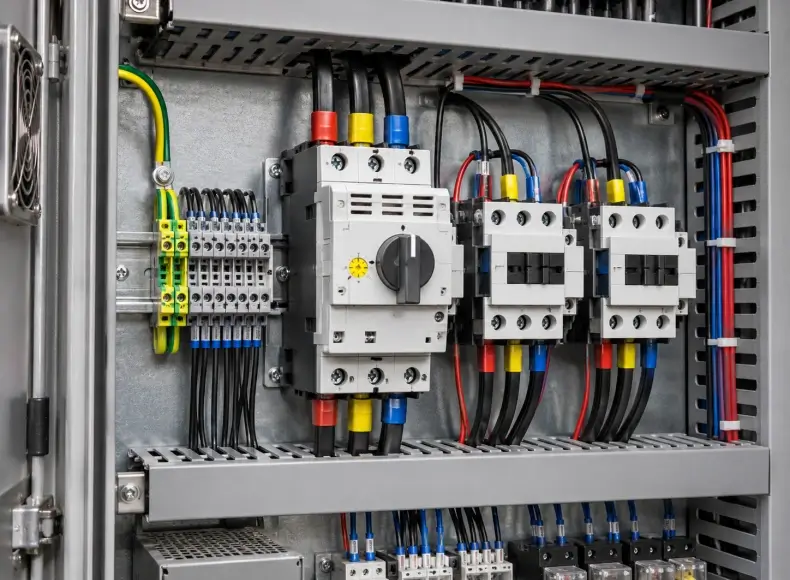
Siemens motor protection circuit breaker tripping is commonly caused by motor overload, a short circuit, phase loss, excessive starting current, or unsuitable protection settings. A Siemens SIRIUS 3RV motor starter protector may also trip because the motor is mechanically overloaded or the electrical installation has developed a fault. The first step is to identify when the trip occurs, verify the breaker settings against the motor nameplate, and investigate the motor feeder before resetting the device. Repeated tripping does not automatically mean the breaker is defective.
Why Does a Siemens Motor Protection Circuit Breaker Trip?
Siemens SIRIUS 3RV motor starter protectors are designed to protect suitable motor circuits from abnormal electrical conditions. Standard motor protection versions combine two important protection functions:
- Thermal overload protection: Responds to excessive current over time, helping protect the motor against overheating.
- Magnetic short-circuit protection: Responds rapidly when the current reaches the specified instantaneous release conditions.
These functions behave differently. A sustained overload may take time to produce a trip, while a severe short circuit can operate the magnetic release rapidly.
Siemens also provides phase-loss-sensitive protection in applicable motor protection versions. However, not every 3RV product has identical protection functions. Special versions designed for starter combinations, transformer protection, or other applications must be assessed according to their individual specifications.
The manufacturer’s SIRIUS 3RV Motor Starter Protectors Equipment Manual explains these operating characteristics and the relevant safety requirements.
Common Siemens 3RV Tripping Symptoms and Possible Causes
The timing of a trip provides useful diagnostic information, but it cannot establish the cause by itself. Use the following table to decide which part of the installation to investigate first.
| Observed Symptom | Possible Cause | First Check |
|---|---|---|
| Breaker trips immediately when the motor starts | Short circuit, high starting current, mechanical blockage, or unsuitable device characteristics | Check the trip indication, motor circuit, starting conditions, and load. |
| Breaker trips after several minutes | Motor overload, excessive heating, incorrect current setting, or poor cooling | Compare operating current with the motor nameplate and breaker setting. |
| Breaker trips during heavy production loads | Load increase, mechanical resistance, or repeated demanding operating cycles | Check the driven equipment and its operating conditions. |
| Breaker trips after a phase-related supply problem | Phase loss or abnormal three-phase motor operation | Investigate the supply, feeder connections, and motor circuit. |
| Breaker trips more frequently in a hot cabinet | Temperature-related installation conditions or excessive loading | Check enclosure temperature, ventilation, spacing, and device requirements. |
| Breaker will not remain closed | Unresolved electrical fault, accessory operation, or internal device damage | Identify the trip state and inspect the relevant circuit under safe conditions. |
A trip that occurs immediately after startup does not always indicate a short circuit. Likewise, a delayed trip does not prove that the motor is overloaded. The breaker’s actual time-current characteristic, thermal state, and fault information must also be considered.
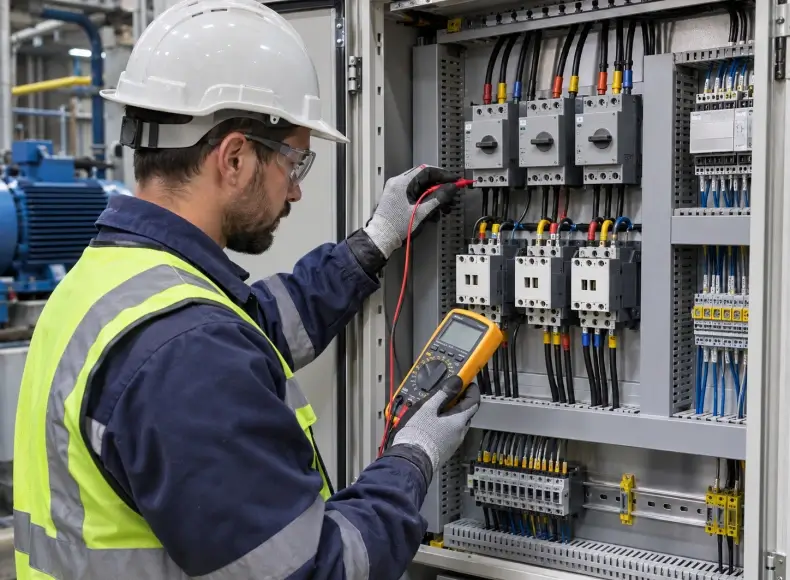
1. Motor Overload: A Common Cause of Delayed Tripping
Motor overload occurs when the motor draws excessive current for longer than the protection system permits. The thermal release responds according to its time-current characteristic and the device’s existing thermal condition.
Consider a conveyor that runs normally when empty but trips after carrying a heavier product load. The increased mechanical resistance may raise the motor current enough to operate the overload protection.
What should you inspect?
- Compare the motor’s rated current with the breaker’s adjustable overload setting.
- Review whether the motor is operating above its intended load.
- Inspect the driven machine for bearing problems, friction, or mechanical obstruction.
- Check whether the motor starts and stops more frequently than intended.
- Review motor cooling and the surrounding environmental conditions.
For example, the Siemens 3RV2021-1HA15 has a documented adjustable overload range of 5.5–8 A. A motor requiring a protection setting outside this range needs a different selection, not an arbitrary adjustment to the available dial.
The Siemens 3RV2021-1HA15 specifications guide explains the model’s overload setting and Class 10 characteristic.
Do not increase the thermal adjustment simply to prevent nuisance trips. Doing so can leave the motor inadequately protected.
2. Immediate Tripping: Short Circuits and Starting Current
When a breaker opens almost immediately after a start command, technicians should investigate the motor circuit and the starting conditions.
Possible causes include:
- A short circuit in the motor supply circuit.
- Damaged motor insulation or connecting cables.
- Incorrect power wiring or a faulty electrical component.
- High starting current that is unsuitable for the selected protection arrangement.
- A mechanically blocked motor that cannot accelerate normally.
Electric motors typically draw substantially more current during starting than during steady operation. The protection device must accommodate the motor’s normal acceleration while still providing the required fault protection.
Siemens discusses the interaction between motor starting characteristics and protection-device selection, including considerations for highly energy-efficient motors, in its SIRIUS 3RV equipment manual.
How should the fault be investigated?
Record whether the trip occurs before the motor turns, during acceleration, or shortly after reaching normal speed. Note whether the event began after a motor, cable, contactor, or protection-device replacement.
Qualified electrical personnel should then investigate the circuit using approved isolation, verification, and testing procedures. Do not repeatedly reclose a breaker onto a suspected short circuit.
If the motor circuit tests satisfactorily, review the device’s actual instantaneous release characteristic and the motor’s expected starting-current profile.
Important: The instantaneous magnetic release threshold is not the same as the breaker’s rated short-circuit breaking capacity. Both specifications must be evaluated separately.
3. Phase Loss and Unbalanced Motor Conditions
A three-phase motor can experience abnormal current and heating when one supply phase is lost. Siemens provides phase-loss-sensitive protection in applicable SIRIUS motor protection breakers.
Possible reasons for phase loss include an interrupted supply conductor, a faulty contactor pole, a disconnected terminal, or a problem elsewhere in the motor feeder.
If a breaker starts tripping after electrical maintenance, the installation should be checked for changes to the supply or motor connections.
Under an approved electrical safety procedure, qualified personnel should assess the incoming supply, feeder connections, associated switching components, and motor circuit.
Not every 3RV device provides the same phase-loss protection. Confirm the exact part number and application-specific function before relying on this behavior for diagnosis.
4. Incorrect Current Settings and Trip Class
A motor protection breaker must be selected and adjusted to match the motor and the relevant protection design. An unsuitable setting can cause repeated trips or leave the motor without the intended protection.
For reference, Siesource has published information on several SIRIUS 3RV2 models:
| Siemens Model | Adjustable Overload Range | Typical Selection Concern |
|---|---|---|
| 3RV2021-1BA15 | 1.4–2 A | Motor rated current and low-current protection |
| 3RV2011-1DA10 | 2.2–3.2 A | Motor current within the available S00 setting range |
| 3RV2021-1HA15 | 5.5–8 A | Starting behavior and motor current selection |
| 3RV2021-4NA15 | 23–28 A | Higher-current motor feeder requirements |
These models are examples of different adjustment ranges, not a list of interchangeable spare parts.
For a lower-current device, review the Siemens 3RV2021-1BA15 motor protection guide, which covers the 1.4–2 A adjustment range and Class 10 characteristics.
Does Class 10 mean the breaker trips after ten seconds?
No. Class 10 describes an overload trip characteristic under defined test conditions. It does not mean that every overload causes a trip after exactly ten seconds.
The actual response depends on the magnitude and duration of overcurrent, the thermal condition of the device, and the relevant manufacturer’s time-current curve.
Before investigating an apparently early trip, confirm whether the device’s trip class is appropriate for the motor starting time and duty cycle.

5. High Ambient Temperature and Poor Cabinet Ventilation
An electrical enclosure may operate at a substantially different temperature from the surrounding factory. Concentrated equipment, inadequate ventilation, and installation conditions can affect the permitted operation of protection devices.
Siemens publishes temperature-related operating restrictions and, for certain devices and arrangements, current corrections or derating requirements.
If tripping becomes more frequent during warm weather or when nearby equipment operates continuously, check:
- The actual enclosure temperature and ventilation arrangement.
- The permitted temperature range of the installed breaker.
- Required mounting clearances and nearby heat-producing equipment.
- The actual motor load and current.
- Any derating specified for the device and installation.
Do not apply one generic temperature correction to every Siemens 3RV model. Follow the data for the complete order number and the installed configuration.
6. Mechanical Problems Can Trigger Electrical Protection
A tripping motor protection breaker may be responding correctly to a mechanical problem outside the control cabinet.
Common examples include a jammed conveyor, blocked pump, seized bearing, overloaded mixer, or excessive resistance in a driven mechanism.
These problems may increase motor current during starting or normal operation, eventually triggering protection.
After safely isolating the equipment, the maintenance team should inspect the driven machine according to its manufacturer’s instructions.
Replacing the breaker without correcting the mechanical cause can result in another trip and potentially damage the equipment.
7. How to Reset a Siemens 3RV Breaker After Tripping
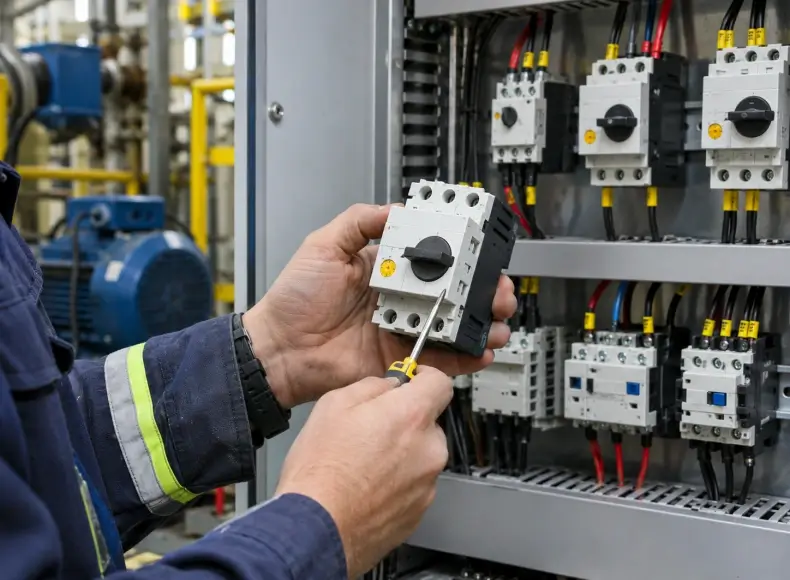
A reset should take place only after qualified personnel have identified the fault, corrected its cause, and confirmed that the motor can restart safely.
Siemens documents different trip indications for the 3RV1.1 and 3RV2 families. In particular, a 3RV2 device moves to a tripped position, while the 3RV1.1 indicates tripping through its OFF position.
For the relevant 3RV2 rotary mechanism, Siemens specifies moving the switch to the O position before reclosing so the mechanism can become ready for operation again.
This does not authorize an immediate restart after a fault. The motor, electrical feeder, and protective assembly must first be safe to energize.
Do not force a mechanism that will not remain closed or repeatedly attempt a reset without resolving the underlying condition.
When Does a Tripping Siemens Motor Protection Breaker Need Replacement?
Repeated tripping alone does not prove that the breaker has failed. A replacement may be necessary when an appropriate inspection identifies damaged hardware, a defective mechanism, unacceptable connection damage, or another confirmed device fault.
Before ordering a replacement, check the following:
- Complete part number: Identify the original Siemens 3RV reference, including its suffix.
- Overload adjustment range: Confirm that the new device can protect the motor’s rated current.
- Trip characteristic: Verify compatibility with the motor’s starting and operating requirements.
- Short-circuit ratings: Compare the applicable breaking capacity with the installation’s prospective fault current.
- Frame and dimensions: Check mounting arrangements, terminal types, and available space.
- Accessories: Record any auxiliary contacts, releases, handles, or connecting components.
- Starter coordination: Confirm the associated contactor and the specified protection arrangement.
For older 3RV1 installations, the Siemens 3RV1 vs 3RV2 replacement guide explains why matching current ranges does not automatically establish compatibility.
If a replacement has been confirmed, you can browse the Siemens circuit breaker product category at Siesource Industrial. The category includes Siemens circuit breaker products; confirm the exact motor protection model before requesting a quotation.
Frequently Asked Questions
Why does my Siemens motor protection circuit breaker trip immediately?
Immediate tripping can result from a short circuit, abnormal starting current, a blocked motor, or an unsuitable protection characteristic. Record the trip indication and have qualified personnel investigate the motor circuit before resetting.
Why does a Siemens 3RV breaker trip after running for several minutes?
A delayed trip may involve sustained motor overload, excessive mechanical resistance, abnormal operating conditions, or an unsuitable overload setting. Compare the actual motor current and operating conditions with the device’s time-current characteristic.
Can I increase the breaker current setting to stop it tripping?
Do not increase the setting simply to prevent trips. The overload adjustment must remain appropriate for the motor nameplate and protection requirements. Investigate the cause before changing any setting.
How do I reset a Siemens 3RV2 motor protection breaker?
After the fault has been corrected and safe restart conditions have been confirmed, the relevant 3RV2 rotary mechanism must be moved to O before reclosing. Follow the exact device instructions and site safety procedures.
Does repeated tripping mean the Siemens 3RV breaker is defective?
No. Repeated tripping can indicate a genuine motor, wiring, starting, or mechanical problem. Consider replacement only after suitable inspection and testing identify a device fault or an unsuitable protection configuration.
Conclusion
Siemens motor protection circuit breaker tripping is a warning that the motor feeder requires investigation. Overload, short circuits, phase loss, starting-current conditions, incorrect settings, and mechanical problems can all contribute to the event.
Identify when the breaker trips, compare its settings with the motor nameplate, and inspect the affected circuit before attempting a reset. If the investigation confirms that the breaker needs replacement, use the complete Siemens part number and verify the electrical and mechanical requirements.
Need a replacement Siemens motor protection breaker? If inspection has identified a specific 3RV model that requires replacement, contact Siesource Industrial for a Siemens 3RV spare-parts enquiry. Include the original model, required quantity, motor specifications, and delivery destination so the requested component can be identified accurately.