


Blog
Why Choose Siemens SITOR Fuses for DC Drive Protection?

In the world of industrial power electronics, Direct Current (DC) drives serve as the backbone for high-precision motor control in industries ranging from steel manufacturing to paper milling. However, the heart of these drives—the power semiconductor—is notoriously fragile. Unlike traditional electromechanical components, components like thyristors and diodes have almost no overload capacity. A single millisecond of excessive current can lead to catastrophic failure, resulting in expensive repairs and significant factory downtime.
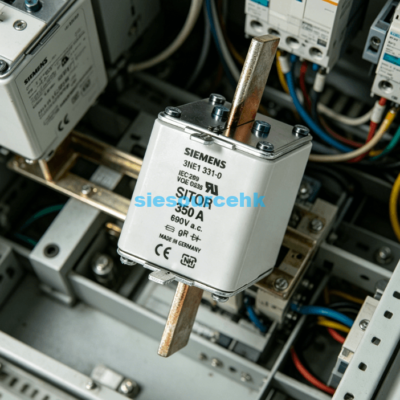
This is where the Siemens SITOR fuse (Semiconductor Intelligent Technical Overcurrent Release) becomes an indispensable component. Engineered specifically for the protection of power semiconductors, SITOR fuses provide a level of speed and thermal coordination that standard industrial fuses simply cannot match. Choosing the right SITOR fuse is not just a matter of electrical safety; it is a strategic decision to ensure the longevity and reliability of high-value industrial assets.
The Technical Necessity of SITOR Fuses in DC Drives
To understand why Siemens SITOR fuses are the industry standard, one must first look at the unique electrical environment of a DC drive. Unlike Alternating Current (AC) systems, DC systems do not have a natural “zero-crossing” where the voltage and current momentarily drop to zero. This makes extinguishing an electrical arc significantly more difficult. When a fault occurs in a DC drive, the fuse must physically force the current to zero by creating an internal arc voltage that opposes the system voltage.
Understanding Semiconductor Thermal Limits
Power semiconductors are characterized by their extremely small thermal mass. The junction of a thyristor can reach its destruction temperature within microseconds if a short circuit occurs. Standard fuses, designed to protect cables (Class gG) or motors (Class aM), are far too slow. They are built to allow temporary surges, which is exactly what a semiconductor cannot withstand.
Siemens SITOR fuses are classified as “ultra-quick.” They utilize specialized internal architectures that respond to high-fault currents in less than 5 milliseconds. By clearing the fault before the semiconductor’s internal temperature exceeds its critical threshold, the SITOR fuse acts as a high-speed thermal barrier.
How DC Faults Differ from AC Faults
In a DC drive architecture, faults can originate from various sources: a flashover in the motor, a failure in the control logic, or an external short circuit in the armature circuit. Because DC current flows continuously, any arc formed during a fuse blow must be actively “quenched.” Siemens SITOR fuses use high-purity quartz sand with specific grain sizes to absorb the energy of the arc and cool it rapidly. This ensures that the fuse body remains intact and the fault is isolated without damaging surrounding components in the control cabinet.
Key Performance Indicators for Siemens SITOR Fuses
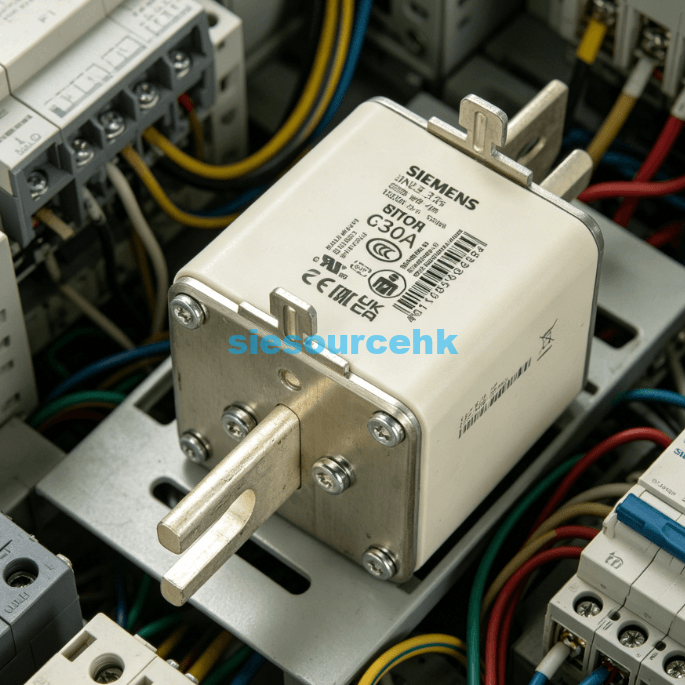
When engineers evaluate fuse options, they look at specific technical data points that define the level of protection. The Siemens SITOR range is optimized to provide the best balance between current-carrying capacity and fault-clearing speed.
| Feature | Standard gG/gL Fuses | Siemens SITOR (aR/gR) |
|---|---|---|
| Primary Target | Cables and slow-acting loads | Semiconductors (Thyristors, IGBTs) |
| Response Speed | Milliseconds to seconds | Microseconds to milliseconds |
| I²t Let-through | High (allows potential damage) | Ultra-low (optimized for protection) |
| DC Capability | Limited and often de-rated | Explicitly rated for high DC voltages |
| Power Dissipation | Lower | Higher (due to fast-acting design) |
The comparison above highlights why substituting a SITOR fuse with a standard industrial fuse is a high-risk error. The “let-through” energy of a standard fuse is often ten times higher than that of a SITOR fuse, which is more than enough to vaporize a semiconductor’s internal connections.
The Critical Role of I²t Values
The most important technical specification for a semiconductor fuse is its $I^2t$ value. This is the measure of thermal energy that the fuse allows to pass into the circuit before it completely interrupts the current.
- Pre-arcing $I^2t$: The energy required to melt the fuse element.
- Total Clearing $I^2t$: The sum of pre-arcing and the energy let through during the arcing phase.
Siemens SITOR fuses are designed to minimize the total clearing $I^2t$. This is achieved by using silver elements with precise notches. These notches act as points of concentrated resistance where the melting starts almost instantaneously during a short circuit. For a DC drive engineer, ensuring the fuse’s total $I^2t$ is lower than the semiconductor’s $I^2t$ rating is the fundamental rule of circuit protection.
DC Voltage and Time Constant (L/R) Management
In DC circuits, the rate at which current rises during a fault is determined by the inductance ($L$) and resistance ($R$) of the circuit, known as the time constant ($L/R$). A high time constant means the current rises more slowly but is much harder to stop. Siemens SITOR fuses are extensively tested for DC applications with varying time constants, often up to 15ms or 20ms. This rigorous testing gives OEMs the confidence that the fuse will perform reliably even in highly inductive motor armature circuits.
Design and Thermal Management Excellence
The physical design of a fuse impacts how it handles heat during normal operation. Since DC drives often run at high duty cycles, the fuse must be able to carry its rated current without aging prematurely or causing excessive heat build-up in the cabinet.
Silver Element Technology
Siemens uses high-purity silver for the internal melting elements of the SITOR series. Silver is chosen because of its exceptional electrical conductivity and its predictable melting characteristics. This precision allows for tighter tolerances in protection curves. In manufacturing environments where consistency is key, the predictability of a SITOR fuse ensures that the system doesn’t suffer from “nuisance blowing”—where a fuse trips during normal operation due to poor thermal design.
Minimizing Power Dissipation in Control Cabinets
Fast-acting fuses naturally generate more heat because their internal elements are thinner at certain points. However, excessive heat can de-rate other electronic components nearby. The Siemens 3NE and 3NC series are engineered to optimize the surface area of the fuse body, often utilizing silver-plated copper end-caps to improve heat transfer to the busbars.
When sourcing these components, it is helpful to consult technical catalogs to match the power loss of the fuse with the ventilation capacity of the drive cabinet. Detailed specifications for these various form factors can be found through specialized Siemens fuse distributors, ensuring the selected model fits the thermal profile of the installation.
Practical Applications and Integration
In a real-world manufacturing facility, the placement of the SITOR fuse within the DC drive system is critical for different types of protection.
Line Protection vs. Armature Protection
There are two primary locations for SITOR fuses in a DC drive system:
- AC Line Side: Fuses placed here protect the entire drive system, including the bridge rectifier, from faults coming from the main power grid.
- DC Armature Side: These fuses are placed between the drive and the motor. They are essential for protecting the drive from “regenerative” faults, where the motor acts as a generator (e.g., during rapid braking or when a hoist descends) and sends a surge of current back into the semiconductors.
Mounting Options and Form Factors
Siemens SITOR fuses are available in several mechanical designs to suit different installation needs:
- NH (Blade) Type: The most common industrial format, offering easy replacement and a secure fit in standard fuse holders.
- Cylindrical Type: Compact designs for smaller DC drives and space-constrained control panels.
- Bolt-on (Bottle) Type: Used in high-current applications where a low-resistance mechanical connection is vital to prevent thermal issues at the contact points.
Summary
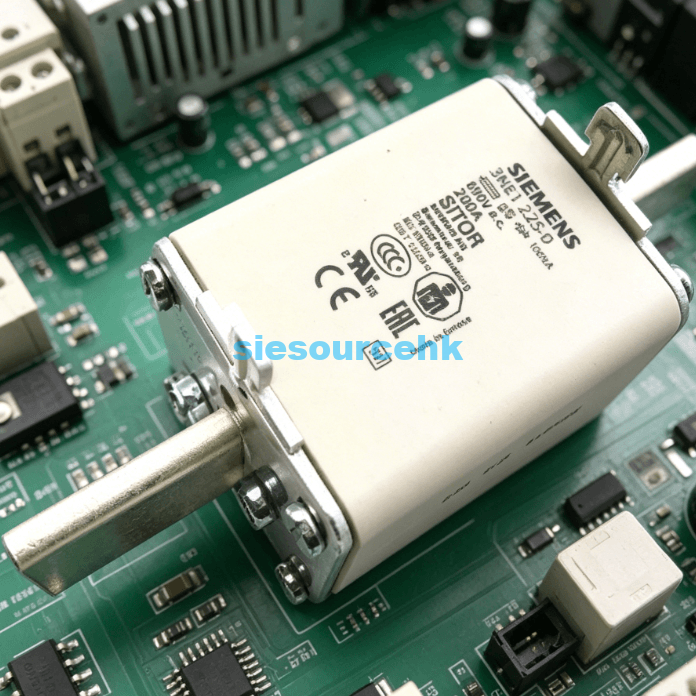
Choosing Siemens SITOR fuses for DC drive protection is a decision rooted in engineering precision and risk management. These fuses provide the ultra-fast interruption speeds required to save sensitive power semiconductors from thermal destruction. By offering low $I^2t$ values, robust DC arc-quenching capabilities, and a variety of form factors, the SITOR range ensures that industrial processes remain productive. While the initial cost of a semiconductor fuse may be higher than a general-purpose fuse, the protection it offers against catastrophic drive failure and lost production time provides a clear and significant return on investment.
| A5E00297617 | A5E00135620 | A5E00166828 | A5E00288852 |
| A5E00296891-002 | A5E00444033 | A5E00470541 6SE7090-0XX84-0AJ0 | A5E00714561 |
| A5E00994796-0 | A5E01195872 | A5E01341031 | A5E02282294 |
| A5E02625805-H2 | A5E03432411FA | A5E03894526 | A5E30947477 |
| A5E30947477 H3 | A5E30947477-H3 | A5E31006890-K8 | A5E31006890-K9 |
| A5E32100313 | A5E32401109 AA | A5E32401109 AB | A5E35931202 |
| A5E36717813 | A5E36968571 | A5E43516128 | A5E00825002 |
| A5E36717788 | A5E36717799 | A5E43382223 | A5E00104.118 |
| A5E00151017 | A5E00215466 | A5E00244584 | A5E00314745 |
| A5E00331143 | A5E00357869 | A5E00369843 | A5E00684817 |
| A5E00714562 | A5E00755411 | A5E00765725 | A5E00768956 |
| A5E01187909 | A5E01708486 | A5E02083152 | A5E02320423 |
| A5E02326861 | A5E02547143 | A5E02630232 | A5E02645922001 |
| A5E02951937 | A5E03915589 | A5E30947477-H4 | A5E32352515-AA |
| A5E32401109 | A5E34345932 | A5E36128806004 | A5E36563512 |
| A5E38083935 | A5E40873334 | A5E42881257 | A5E43523091 |
| A5E45777827001 |
FAQ
1. Can I use a standard AC fuse in a DC drive application?
No, you should never use a standard AC-only fuse in a DC circuit. AC fuses rely on the natural zero-crossing of the voltage to extinguish an arc. In a DC fault, the arc is continuous and much more energetic. Using an AC fuse can lead to the fuse failing to clear the fault, which may result in a fire, explosion, or complete destruction of the DC drive.
2. What is the difference between Class aR and Class gR Siemens SITOR fuses?
Class aR fuses provide partial-range protection, meaning they are designed specifically for ultra-fast short-circuit clearing but do not protect against low-level overloads. They are usually paired with the drive’s internal electronic protection. Class gR fuses provide full-range protection, covering both short circuits and long-term overloads. Most DC drive applications utilize Class aR for maximum semiconductor protection speed.
3. How do I choose the correct current rating for a SITOR fuse?
The nominal current of the fuse should be slightly higher than the maximum continuous current of the drive. However, you must apply de-rating factors based on the ambient temperature inside the cabinet and whether the fuse is mounted in a closed holder or on an open busbar. Always refer to the Siemens manufacturer de-rating curves for precise selection.
4. Why are silver elements used in SITOR fuses instead of copper?
Silver has better electrical conductivity and, more importantly, does not oxidize as easily as copper at the high operating temperatures found inside a fuse. This ensures that the fuse’s tripping characteristics remain stable over many years of service. Silver also allows for more precise control over the $I^2t$ values during the manufacturing process.
5. Does the orientation of the fuse mounting matter?
For most NH-type SITOR fuses, the orientation does not significantly affect electrical performance. However, for thermal reasons, vertical mounting is often preferred to allow for natural air convection. If several fuses are mounted closely together, additional de-rating may be required due to the mutual heating effect.
6. Can SITOR fuses be used to protect IGBTs in modern drives?
Yes, SITOR fuses are widely used to protect Insulated Gate Bipolar Transistors (IGBTs) in both DC drives and AC variable frequency drives (VFDs). While IGBTs are even faster than thyristors, the SITOR series provides the necessary “ultra-quick” clearing time to minimize damage during a “shoot-through” or short-circuit event.
Reference Sources
Siemens official SITOR semiconductor fuse technical data.